

Federalist 18
100 Days of The Federalist Papers; March 1-May 31, 2026

100 Days of The Federalist Papers
March 1-May 31, 2026
March 26, 2026
Federalist 18
(March 27 - Federalist 19, 20, 21)
Federalist No. 18
The Same Subject Continued: The Insufficiency of the Present Confederation to Preserve the Union From the Independent Journal
Alexander Hamilton and James Madison
To the People of the State of New York:
What happens when the brilliant minds of Hamilton and Madison are united for a set of three Federalist essays (18-20)?! Intellectual fireworks!!! In a tour de force evaluation of the often catastrophic drawbacks of past confederations, from the Greek Amphictyonic League to the Holy Roman Empire, Hamilton and Madison make an erudite and measured argument for the consolidation of the 13 states of the newly formed republic into a strong and united federal state – governed by the Constitution for which they advocate.
“Among the confederacies of antiquity, the most considerable was that of the Grecian republics, associated under the Amphictyonic council. From the best accounts transmitted of this celebrated institution, it bore a very instructive analogy to the present Confederation of the American States.”
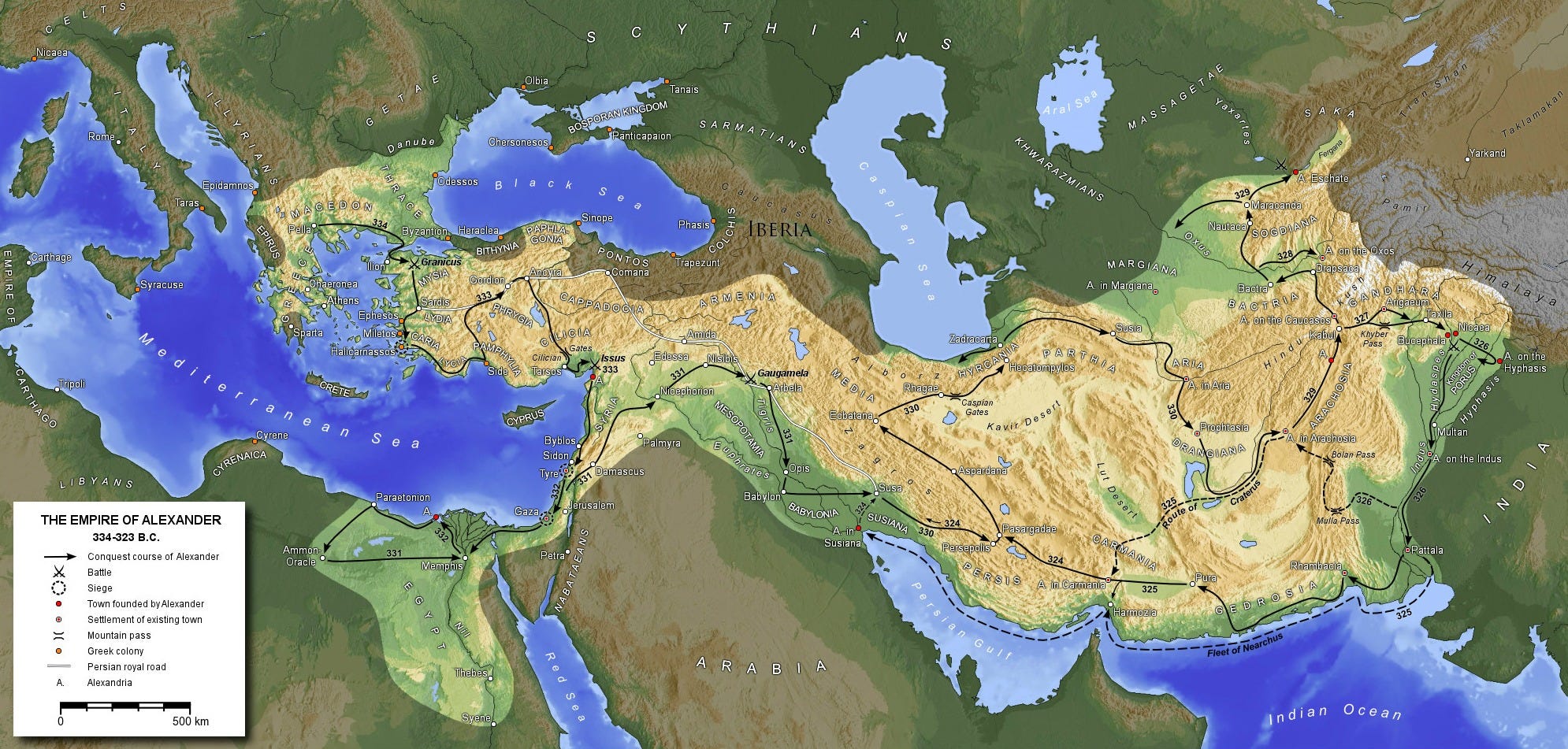
The disunited nature of the 6th century BC Amphictyonic League caused internal discord between the Greek city-states - such as Athens, Sparta, Themes, and Mycenae – and invited external interventions – notably from the powerful northern state of Macedonia. Philip of Macedon (382 BC-336 BC) conquered Greece – and his legendary son Alexander (356 BC-323 BC) marched off to Persia, today’s Iran, and created an empire that extended from the Danube to Egypt and from Greece to India. This enormous territory could not be held together after his death – it too fractured – with the new state harboring imperial ambitions, Rome, utilizing Greek weakness and disunity and incorporating the entirety of Greece into the Roman Empire. With the collapse of the Western Roman Empire in the 5th century, Greece became a part of the Greek-speaking Eastern Roman Empire, with its capital in Constantinople. The next empire to rule Greece was the Ottoman Turkish Empire – which conquered Constantinople in 1453. At the time of the composition of the Federalist Papers, Greece was still under Turkish rule – which ended with the Greek War of Independence in 1821 (Lord Byron joined the fight for Greek independence and died fighting for the cause in 1824). Yes, the disjointed nature of the Greek city-states resulted in Greece losing its independence for a staggering 22 centuries…
“Very different, nevertheless, was the experiment from the theory.
The powers, like those of the present Congress, were administered by deputies appointed wholly by the cities in their political capacities; and exercised over them in the same capacities. Hence the weakness, the disorders, and finally the destruction of the confederacy. The more powerful members, instead of being kept in awe and subordination, tyrannized successively over all the rest. Athens, as we learn from Demosthenes, was the arbiter of Greece seventy-three years. The Lacedaemonians (Sparta) next governed it twenty-nine years; at a subsequent period, after the battle of Leuctra, the Thebans had their turn of domination.”
Plutarch’s (50-120AD) “Parallel Lives,” a set of 48 essays detailing the lives of notable Greek and Roman historical figures, was one of Hamilton’s favorite books – he carried the thick tome with him all through the Revolutionary War.
“It happened but too often, according to Plutarch, that the deputies of the strongest cities awed and corrupted those of the weaker; and that judgment went in favor of the most powerful party.
Even in the midst of defensive and dangerous wars with Persia and Macedon, the members never acted in concert, and were, more or fewer of them, eternally the dupes or the hirelings of the common enemy. The intervals of foreign war were filled up by domestic vicissitudes convulsions, and carnage.”
The Persian Wars (499-449BC), between the Greek city-states and Persia under the leadership of Xerxes, which included the famous battles of Marathon, Thermopylae, Salamis, and Plataea, resulted in a Geek victory – secured by the staggering courage of the Lacedaemonians (Spartans) – such as the 300 Spartans at the Battle of Thermopylae (480 BC).
“After the conclusion of the war with Xerxes, it appears that the Lacedaemonians required that a number of the cities should be turned out of the confederacy for the unfaithful part they had acted. The Athenians, finding that the Lacedaemonians would lose fewer partisans by such a measure than themselves, and would become masters of the public deliberations, vigorously opposed and defeated the attempt.”
“Had the Greeks, says the Abbe Milot, been as wise as they were courageous, they would have been admonished by experience of the necessity of a closer union, and would have availed themselves of the peace which followed their success against the Persian arms, to establish such a reformation. Instead of this obvious policy, Athens and Sparta, inflated with the victories and the glory they had acquired, became first rivals and then enemies; and did each other infinitely more mischief than they had suffered from Xerxes. Their mutual jealousies, fears, hatreds, and injuries ended in the celebrated Peloponnesian war; which itself ended in the ruin and slavery of the Athenians who had begun it.”
Internal weakness proved deadly for the independence of Greece – and the fate of the Greek civilization.
“The Phocians, being abetted by Athens and Sparta, refused to submit to the decree. The Thebans, with others of the cities, undertook to maintain the authority of the Amphictyons, and to avenge the violated god. The latter, being the weaker party, invited the assistance of Philip of Mace-don, who had secretly fostered the contest. Philip gladly seized the opportunity of executing the designs he had long planned against the liberties of Greece. By his intrigues and bribes he won over to his interests the popular leaders of several cities; by their influence and votes, gained admission into the Amphictyonic council, and by his arts and his arms, made himself master of the confederacy.”
Then came Rome…
“Such were the consequences of the fallacious principle on which this interesting establishment was founded. Had Greece, says a judicious observer on her fate, been united by a stricter confederation, and persevered in her union, she would never have worn the chains of Macedon; and might have proved a barrier to the vast projects of Rome.”
But first, Greece was conquered by the Macedonian kings…
“All Greece caught the enthusiasm and seemed ready to unite in one confederacy, when the jealousy and envy in Sparta and Athens, of the rising glory of the Achaeans, threw a fatal damp on the enterprise. The dread of the Macedonian power induced the league to court the alliance of the Kings of Egypt and Syria, who, as successors of Alexander, were rivals of the king of Macedon. This policy was defeated by Cleomenes, king of Sparta, who was led by his ambition to make an unprovoked attack on his neighbors, the Achaeans, and who, as an enemy to Macedon, had interest enough with the Egyptian and Syrian princes to effect a breach of their engagements with the league.”
Romans thrived on exploring the weaknesses and disorganization of their opponents:
“Finding themselves, though thus supported, unequal to the undertaking, they once more had recourse to the dangerous expedient of introducing the succor of foreign arms. The Romans, to whom the invitation was made, eagerly embraced it. Philip was conquered; Macedon subdued. A new crisis ensued to the league. Dissensions broke out among its members.
These the Romans fostered. Callicrates and other popular leaders became mercenary instruments for inveigling their countrymen. The more effectually to nourish discord and disorder the Romans had, to the astonishment of those who confided in their sincerity, already proclaimed universal liberty’ throughout Greece.”
Greece did not begin to recover its independence till 1821 – it was recognized as a sovereign and independent state in 1830 – for the first time since the 4th century BC…
“By these arts this union, the last hope of Greece, the last hope of ancient liberty, was torn into pieces; and such imbecility and distraction introduced that the arms of Rome found little difficulty in completing the ruin which their arts had commenced. The Achaeans were cut to pieces, and Achaia loaded with chains, under which it is groaning at this hour.”
Largest extend of Alexander the Great’s empire 334-323BC.
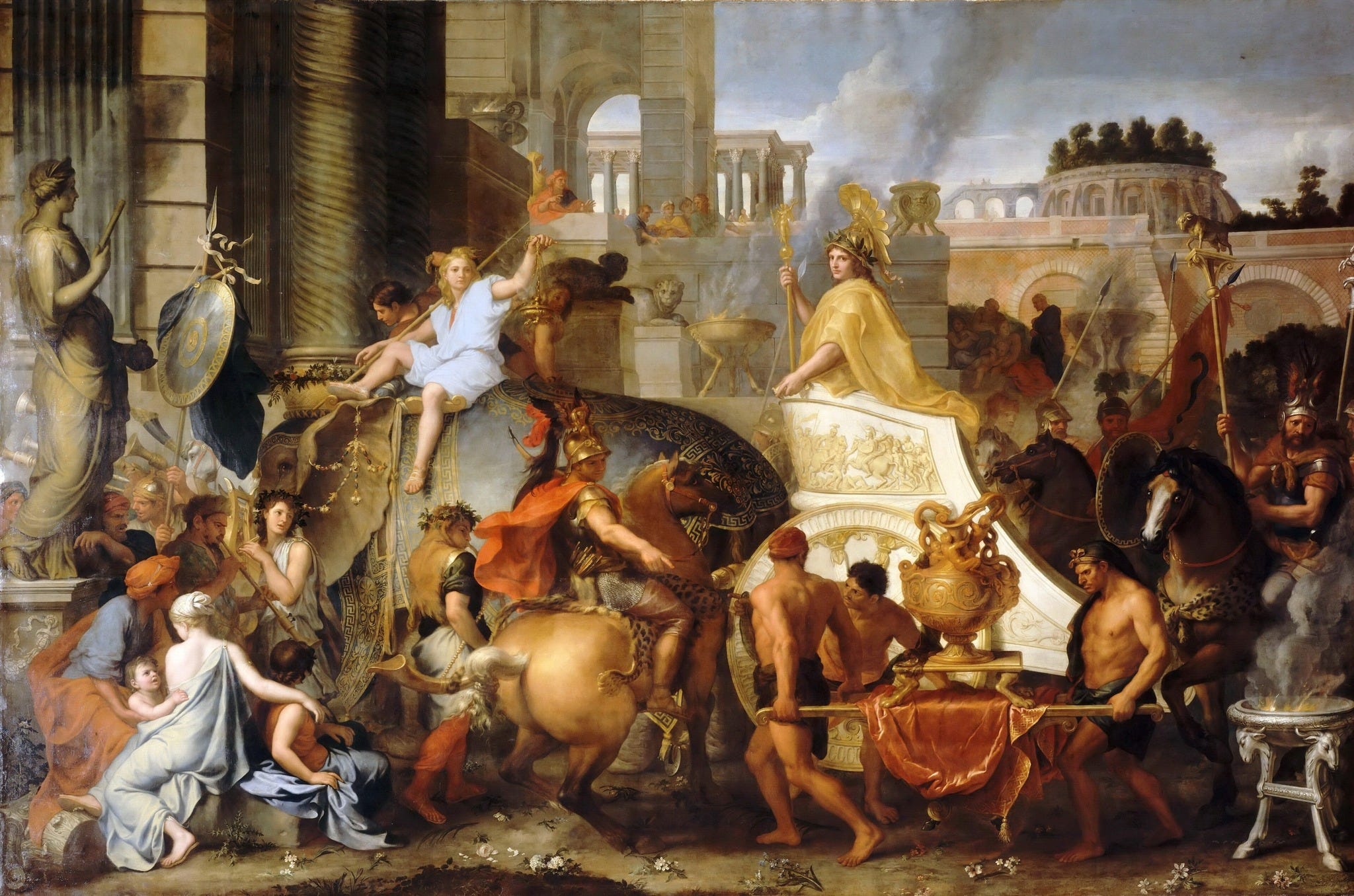
Entry of Alexander into Babylon (1665), by Charles Le Brun (1619-1690).
What another history lesson. Woofda!