

Federalist 29
100 Days of The Federalist Papers; March 1-May 31, 2026

100 Days of The Federalist Papers
March 1-May 31, 2026
April 7, 2026
As many of my readers found out today, for an absolutely mysterious reason I was completely suspended from social media - Instagram, Facebook, and ALL of my literary tutorials… I made an appointment to address this issue with a tech support assistant tomorrow at 5 PM - stay tuned… Needless to say, yesterday was spent in hopeless and helpless attempts to remedy the situation…
I read all 7 Federalist essays we are considering this week - will post a comment on just one of the essays today - dedicate tomorrow to tech mayhem - and will post my commentary on the remaining essays on Thursday and Saturday. The subject of these essays is beyond thrilling - taxes!!! Just in time for April 15!!
Federalist No. 29
Concerning the Militia From the Daily Advertiser.
Thursday, January 10, 1788
Alexander Hamilton
To the People of the State of New York:
How to insure national security? Through the provisions of state militias or a national army?
“It requires no skill in the science of war to discern that uniformity in the organization and discipline of the militia would be attended with the most beneficial effects, whenever they were called into service for the public defense.”
“Of the different grounds which have been taken in opposition to the plan of the convention, there is none that was so little to have been expected, or is so untenable in itself, as the one from which this particular provision has been attacked. If a well-regulated militia be the most natural defense of a free country, it ought certainly to be under the regulation and at the disposal of that body which is constituted the guardian of the national security. If standing armies are dangerous to liberty, an efficacious power over the militia, in the body to whose care the protection of the State is committed, ought, as far as possible, to take away the inducement and the pretext to such unfriendly institutions. If the federal government can command the aid of the militia in those emergencies which call for the military arm in support of the civil magistrate, it can the better dispense with the employment of a different kind of force. If it cannot avail itself of the former, it will be obliged to recur to the latter. To render an army unnecessary, will be a more certain method of preventing its existence than a thousand prohibitions upon paper.”
Is there a danger in federal funding for a national army? This point was hotly debated between the supporters of Hamilton, the federalists, and Jefferson, the republicans. Jefferson and his ideological supporters were fearful that a large and well provisioned army may be utilized by a charismatic general and used to gain access to power and overthrow the republic. Hamilton’s instance that a well-funded army is necessary for national defense was countered with the examples of Julius Caesar and Oliver Cromwell (of whom I wrote in my January column), who used their popularity with the military to take over the governments in Rome (44 BC) and in London (1653) - thus overthrowing the Roman Republic and the British Interregnum Republic.
“What reason could there be to infer, that force was intended to be the sole instrument of authority, merely because there is a power to make use of it when necessary? What shall we think of the motives which could induce men of sense to reason in this manner? How shall we prevent a conflict between charity and judgment?”
“There is something so far-fetched and so extravagant in the idea of danger to liberty from the militia, that one is at a loss whether to treat it with gravity or with raillery; whether to consider it as a mere trial of skill, like the paradoxes of rhetoricians; as a disingenuous artifice to instil prejudices at any price; or as the serious offspring of political fanaticism. Where in the name of common-sense, are our fears to end if we may not trust our sons, our brothers, our neighbors, our fellow-citizens?”
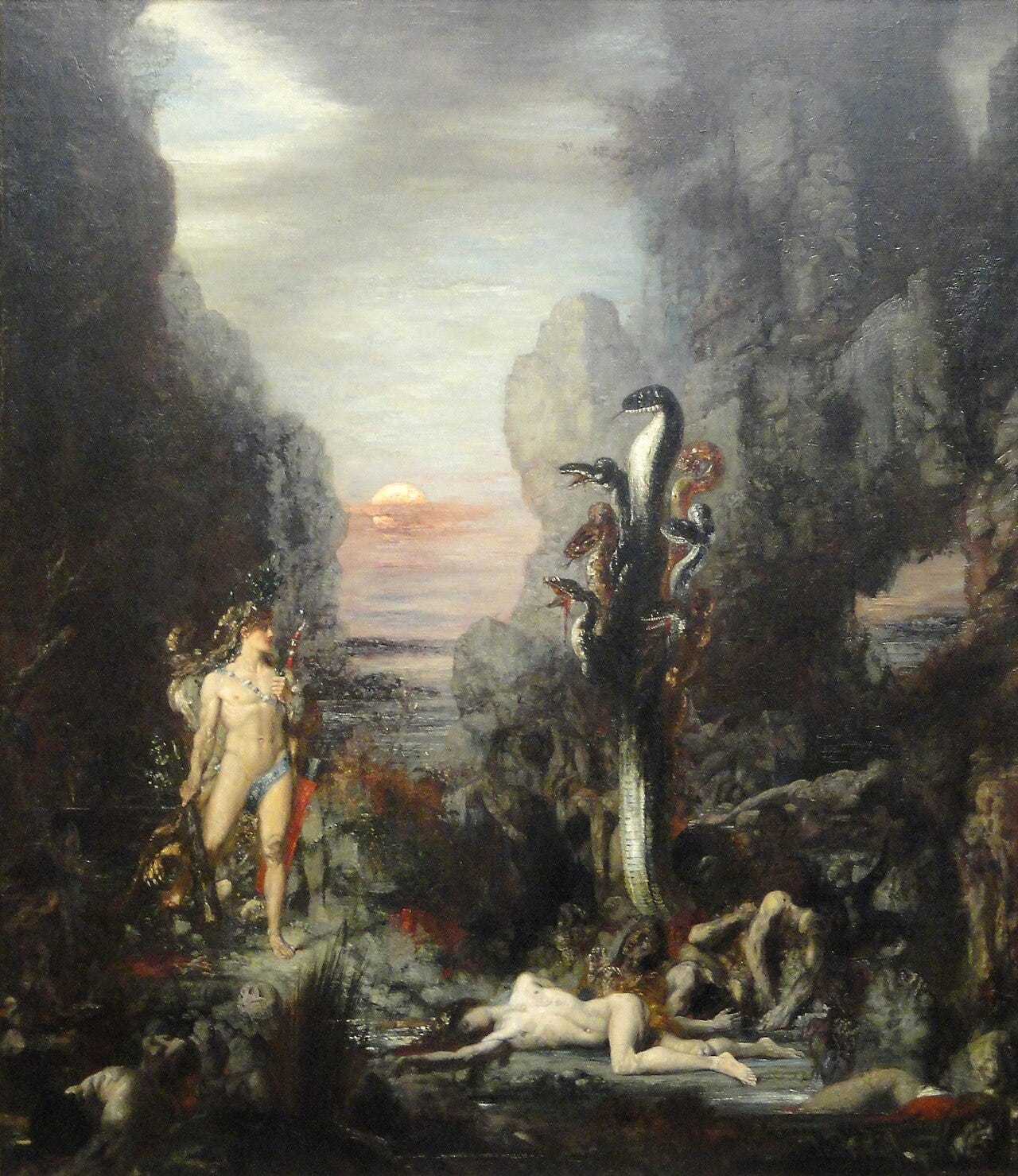
Hamilton mocks the opposition to a national army - which he likens to the irrational fear of mythical beings, such as “gorgons, hydras, and chimeras”:
“In reading many of the publications against the Constitution, a man is apt to imagine that he is perusing some ill-written tale or romance, which instead of natural and agreeable images, exhibits to the mind nothing but frightful and distorted shapes “Gorgons, hydras, and chimeras dire”; discoloring and disfiguring whatever it represents, and transforming everything it touches into a monster.”
If in state emergencies neighboring states can assist each other - why not a unified command for an army consisting of all states?
“In times of insurrection, or invasion, it would be natural and proper that the militia of a neighboring State should be marched into another, to resist a common enemy, or to guard the republic against the violence of faction or sedition. This was frequently the case, in respect to the first object, in the course of the late war; and this mutual succor is, in-deed, a principal end of our political association. If the power of affording it be placed under the direction of the Union, there will be no danger of a supine and listless inattention to the dangers of a neighbor, till its near approach had superadded the incitements of self-preservation to the too feeble impulses of duty and sympathy.”
Hercules and the Lernaean Hydra, 1875-1876, by Gustave Moreau (1826-1898), Art Institute of Chicago. The Hydra was a multi-headed Greek mythological creature with a powerful regenerative impulse - for every head chopped off, the Hydra would grow two new heads. Hercules defeated the monster by burning each cut to prevent healing and regeneration. Defeating the Lernaean Hydra was one of the Twelve Labors of Hercules.
I was happy to hear what was happening Anna, good luck. the commentaries really help me understand the books we study.