Federalist 58, 59, 60
100 Days of The Federalist Papers; March 1-May 31, 2026

100 Days of The Federalist Papers
March 1-May 31, 2026
May 12, 2026
Federalist 58, 59, 60
Once again, all caught up on the reading - need to finish the commentary for last week - and the commentary for this week by the weekend!!! Three weeks to go!!! 21 essays after today’s commentary!!! Plus - stay tuned - Alexander Hamilton related surprises later this week!!!
Federalist No. 58
Objection that The Number of Members Will Not Be Augmented as the Progress of Population Demands Considered
James Madison
To the People of the State of New York:
On the number of members in the House of Representatives adjusted for population growth:
“The remaining charge against the House of Representatives, which I am to examine, is grounded on a supposition that the number of members will not be augmented from time to time, as the progress of population may demand. It has been admitted, that this objection, if well supported, would have great weight. The following observations will show that, like most other objections against the Constitution, it can only proceed from a partial view of the subject, or from a jealousy which discolors and disfigures every object which is beheld.”
How to readjust the apportionment of representatives:
“The unequivocal objects of these regulations are, first, to readjust, from time to time, the apportionment of representatives to the number of inhabitants, under the single exception that each State shall have one representative at least; secondly, to augment the number of representatives at the same periods, under the sole limitation that the whole number shall not exceed one for every thirty thousand inhabitants.”
Who holds the purse of government?! The House of Representatives:
“The House of Representatives cannot only refuse, but they alone can propose, the supplies requisite for the support of government. They, in a word, hold the purse that powerful instrument by which we behold, in the history of the British Constitution, an infant and humble representation of the people gradually enlarging the sphere of its activity and importance, and finally reducing, as far as it seems to have wished, all the overgrown prerogatives of the other branches of the government.”
Congressional spending controlled by the electorate through regular elections:
“This power over the purse may, in fact, be regarded as the most complete and effectual weapon with which any constitution can arm the immediate representatives of the people, for obtaining a redress of every grievance, and for carrying into effect every just and salutary measure.”
Federalist No. 59
Concerning the Power of Congress to Regulate the Election of Members
From the New York Packet.
Friday, February 22, 1788.
Alexander Hamilton
To the People of the State of New York:
On the regulation of the US Senate:
“The senators are to be chosen for the period of six years; there is to be a rotation, by which the seats of a third part of them are to be vacated and replenished every two years; and no State is to be entitled to more than two senators; a quorum of the body is to consist of sixteen members. The joint result of these circumstances would be, that a temporary combination of a few States to intermit the appointment of senators, could neither annul the existence nor impair the activity of the body; and it is not from a general and permanent combination of the States that we can have anything to fear.”
Elections to the Senate and the House of Representatives:
“But with regard to the federal House of Representatives, there is intended to be a general election of members once in two years. If the State legislatures were to be invested with an exclusive power of regulating these elections, every period of making them would be a delicate crisis in the national situation, which might issue in a dissolution of the Union, if the leaders of a few of the most important States should have entered into a previous conspiracy to prevent an election.”
Federalist No. 60
The Same Subject Continued: Concerning the Power of Congress to Regulate the Election of Members From the New York Packet.
Tuesday, February 26, 1788.
Alexander Hamilton
To the People of the State of New York:
The qualifications of the persons who may choose or be chosen to serve in US Congress:
“But upon what principle is the discrimination of the places of election to be made, in order to answer the purpose of the meditated preference? Are “the wealthy and the well-born,” as they are called, confined to particular spots in the several States? Have they, by some miraculous instinct or foresight, set apart in each of them a common place of residence? Are they only to be met with in the towns or cities? Or are they, on the contrary, scattered over the face of the country as avarice or chance may have happened to cast their own lot or that of their predecessors? If the latter is the case, (as every intelligent man knows it to be,’) is it not evident that the policy of confining the places of election to particular districts would be as subversive of its own aim as it would be exceptionable on every other account? The truth is, that there is no method of securing to the rich the preference apprehended, but by prescribing qualifications of property either for those who may elect or be elected. But this forms no part of the power to be conferred upon the national government. Its authority would be expressly restricted to the regulation of the times, the places, the manner of elections. The qualifications of the persons who may choose or be chosen, as has been remarked upon other occasions, are defined and fixed in the Constitution, and are unalterable by the legislature.”
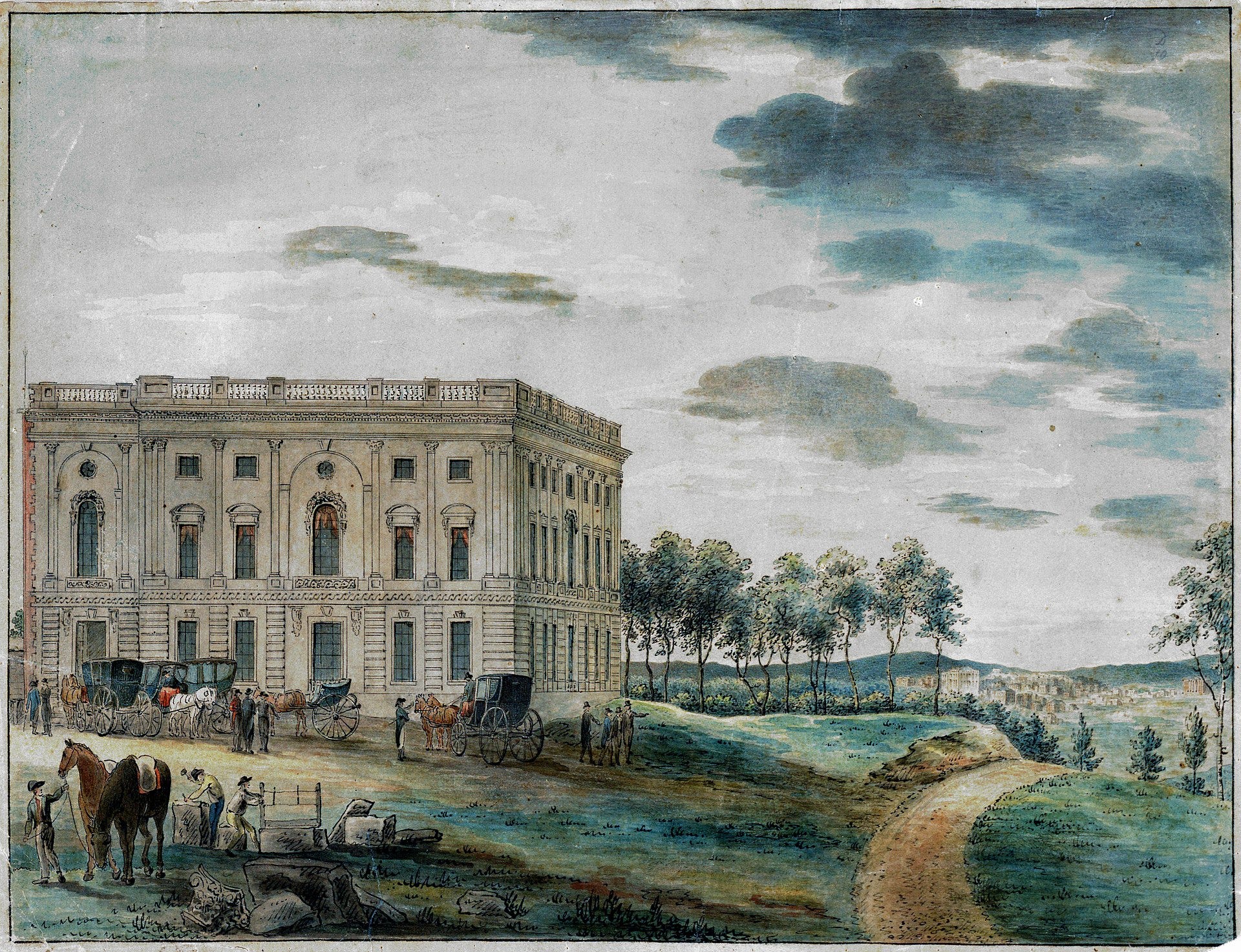
US Capitol in 1800. Construction began in 1793 with President George Washington laying the cornerstone. Initial contraction was completed in 1826 - with major repairs needed in 1814 after the British troops set it on fire during the War of 1812. The building was expanded twice, 1856-1866 and 1958-1962.