Federalist 61, 62, 63
100 Days of The Federalist Papers; March 1-May 31, 2026

100 Days of The Federalist Papers
March 1-May 31, 2026
May 12, 2026
Federalist 61, 62, 63
Back to Hamilton!!!
Federalist No. 61
The Same Subject Continued: Concerning the Power of Congress to Regulate the Election of Members From the New York Packet.
Tuesday, February 26, 1788.
Alexander Hamilton
To the People of the State of New York:
On the necessity of general elections:
“If each State may choose its own time of election, it is possible there may be at least as many different periods as there are months in the year. The times of election in the several States, as they are now established for local purposes, vary between extremes as wide as March and November. The consequence of this diversity would be that there could never happen a total dissolution or renovation of the body at one time. If an improper spirit of any kind should happen to prevail in it, that spirit would be apt to infuse itself into the new members, as they come forward in succession. The mass would be likely to remain nearly the same, assimilating constantly to itself its gradual accretions. There is a contagion in example which few men have sufficient force of mind to resist. I am inclined to think that treble the duration in office, with the condition of a total dissolution of the body at the same time, might be less formidable to liberty than one third of that duration subject to gradual and successive alterations.”
On the importance of election uniformity:
“Uniformity in the time of elections seems not less requisite for executing the idea of a regular rotation in the Senate, and for conveniently assembling the legislature at a stated period in each year.”
Federalist No. 62
The Senate
For the Independent Journal.
Alexander Hamilton or James Madison
To the People of the State of New York:
Qualifications for serving in the US Senate:
“Having examined the constitution of the House of Representatives, and answered such of the objections against it as seemed to merit notice, I enter next on the examination of the Senate.
The heads into which this member of the government may be considered are: I. The qualification of senators; II. The appointment of them by the State legislatures; III. The equality of representation in the Senate; IV. The number of senators, and the term for which they are to be elected; V. The powers vested in the Senate.”
Reasons for age and residency qualifications:
“The qualifications proposed for senators, as distinguished from those of representatives, consist in a more advanced age and a longer period of citizenship. A senator must be thirty years of age at least; as a representative must be twenty-five. And the former must have been a citizen nine years; as seven years are required for the latter. The propriety of these distinctions is explained by the nature of the senatorial trust, which, requiring greater extent of information and stability of character, requires at the same time that the senator should have reached a period of life most likely to supply these advantages; and which, participating immediately in transactions with foreign nations, ought to be exercised by none who are not thoroughly weaned from the prepossessions and habits incident to foreign birth and education. The term of nine years appears to be a prudent mediocrity between a total exclusion of adopted citizens, whose merits and talents may claim a share in the public confidence, and an indiscriminate and hasty admission of them, which might create a channel for foreign influence on the national councils.”
On the necessity of order and stability:
“But the most deplorable effect of all is that diminution of attachment and reverence which steals into the hearts of the people, towards a political system which betrays so many marks of infirmity, and disappoints so many of their flattering hopes. No government, any more than an individual, will long be respected without being truly respectable; nor be truly respectable, without possessing a certain portion of order and stability.”
Federalist No. 63
The Senate Continued For the Independent Journal.
Alexander Hamilton or James Madison
To the People of the State of New York:
Deliberation of historical examples of republics and their governance:
“Sparta, Rome, and Carthage are, in fact, the only states to whom that character can be applied. In each of the two first there was a senate for life. The constitution of the senate in the last is less known. Circumstantial evidence makes it probable that it was not different in this particular from the two others. It is at least certain, that it had some quality or other which rendered it an anchor against popular fluctuations; and that a smaller council, drawn out of the senate, was appointed not only for life, but filled up vacancies itself. These examples, though as unfit for the imitation, as they are repugnant to the genius, of America, are, notwithstanding, when compared with the fugitive and turbulent existence of other ancient republics, very instructive proofs of the necessity of some institution that will blend stability with liberty.”
On the importance of the electoral process - in historical perspective:
“In the most pure democracies of Greece, many of the executive functions were performed, not by the people themselves, but by officers elected by the people, and representing the people in their executive capacity.”
“Prior to the reform of Solon, Athens was governed by nine Archons, annually elected by the people at large. The degree of power delegated to them seems to be left in great obscurity. Subsequent to that period, we find an assembly, first of four, and afterwards of six hundred members, annually elected by the people; and partially representing them in their legislative capacity, since they were not only associated with the people in the function of making laws, but had the exclusive right of originating legislative propositions to the people. The senate of Carthage, also, whatever might be its power, or the duration of its appointment, appears to have been elective by the suffrages of the people. Similar instances might be traced in most, if not all the popular governments of antiquity.”
US senators were appointed by state legislatures till 1912 when the Seventeenth Amendment was passed establishing direct election of US senators. The concern for the inaccessibility and unaccountability of senators was addressed by Hamilton:
“In answer to all these arguments, suggested by reason, illustrated by examples, and enforced by our own experience, the jealous adversary of the Constitution will probably content himself with repeating, that a senate appointed not immediately by the people, and for the term of six years, must gradually acquire a dangerous pre-eminence in the government, and finally transform it into a tyrannical aristocracy.”
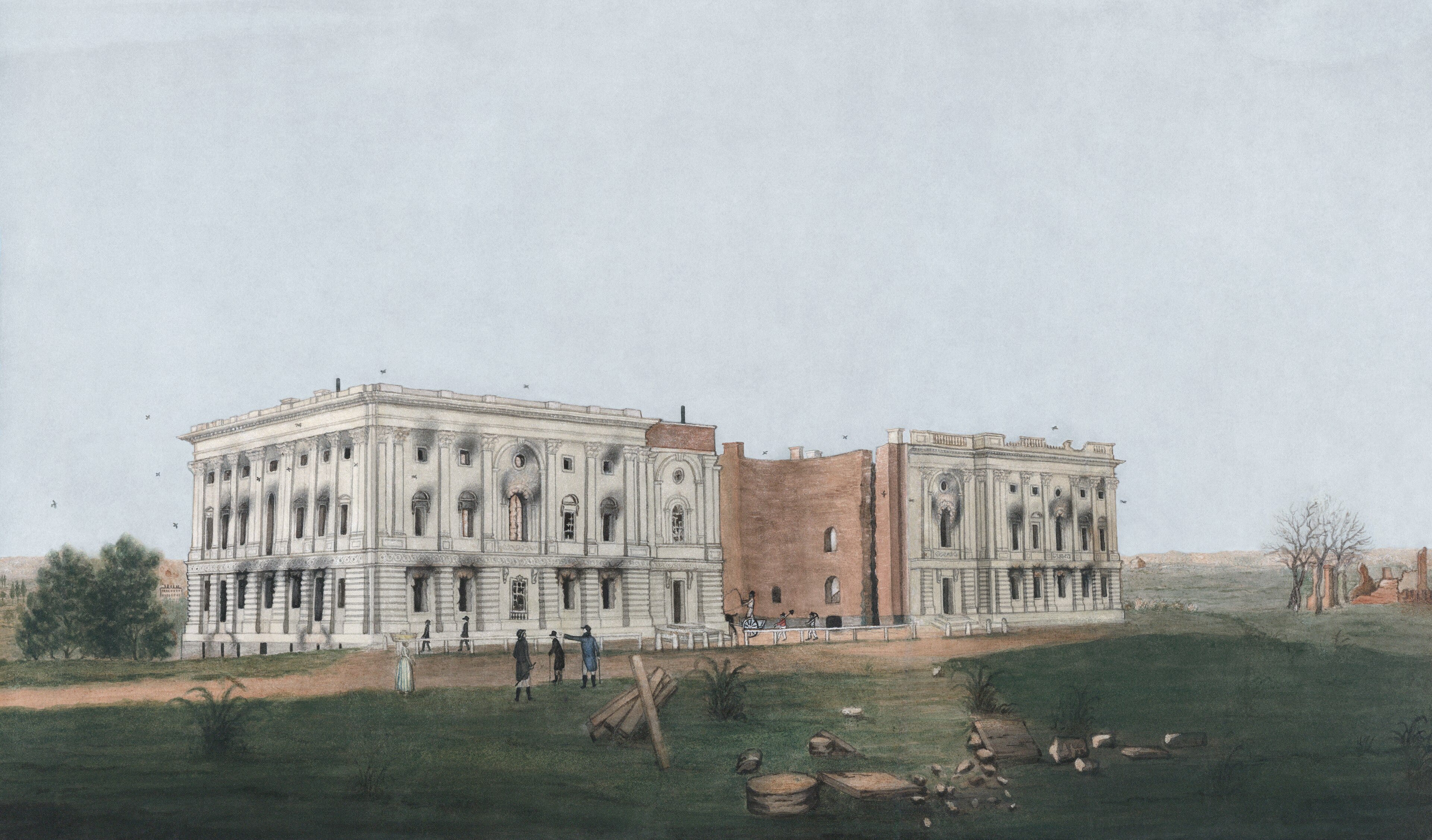
US Capitol after the 1814 burning by the British troops during the War of 1812.