Federalist 64
100 Days of The Federalist Papers; March 1-May 31, 2026

100 Days of The Federalist Papers
March 1-May 31, 2026
May 12, 2026
Federalist 64
After Federalist 2, 3, 4, and 5 - the FINAL John Jay Federalist essay - 64!!! On the role of the Senate in the ratification of treaties. Jay, along with John Adams and Ben Franklin, negotiated the Paris Treaty of 1783 which ended military hostilities between the newly formed US and Britain, who recognized US independence. The 1794 Jay’s Treaty (Treaty of Amity, Commerce, and Navigation), negotiated between the then Chief Justice of the Supreme Court John Jay and Great Britain, established the border between the US and the British Canadian provinces, guaranteed US neutrality in the ongoing war between Britain and Revolutionary France, and established the US as the preferred trading partner of the UK. The treaty was deeply controversial because it prioritized British interests. Yet it offered US the much needed trading deals which allowed it to recover from the Revolutionary War.
Federalist No. 64
The Powers of the Senate From the New York Packet.
Friday, March 7, 1788.
John Jay
To the People of the State of New York:
Jay, the consummate lawyer and diplomate, penned his final essays on treaty ratifications:
“The second section gives power to the President, “By and with the advice and consent of the Senate, to make treaties, provided two thirds of the senators present concur.”
The power of making treaties is an important one, especially as it relates to war, peace, and commerce; and it should not be delegated but in such a mode, and with such precautions, as will afford the highest security that it will be exercised by men the best qualified for the purpose, and in the manner most conducive to the public good. The convention appears to have been attentive to both these points: they have directed the President to be chosen by select bodies of electors, to be deputed by the people for that express purpose; and they have committed the appointment of senators to the State legislatures. This mode has, in such cases, vastly the advantage of elections by the people in their collective capacity, where the activity of party zeal, taking the advantage of the supineness, the ignorance, and the hopes and fears of the unwary and interested, often places men in office by the votes of a small proportion of the electors.”
Treaties must be negotiated by knowledgeable professionals - the proceedings must be kept secret and secure:
“Thus we see that the Constitution provides that our negotiations for treaties shall have every advantage which can be derived from talents, information, integrity, and deliberate investigations, on the one hand, and from secrecy and dispatch on the other.”
On the role of the US government in treaty negotiations and ratifications:
“Some are displeased with it, not on account of any errors or defects in it, but because, as the treaties, when made, are to have the force of laws, they should be made only by men invested with legislative authority. These gentlemen seem not to consider that the judgments of our courts, and the commissions constitutionally given by our governor, are as valid and as binding on all persons whom they concern, as the laws passed by our legislature. All constitutional acts of power, whether in the executive or in the judicial department, have as much legal validity and obligation as if they proceeded from the legislature; and therefore, whatever name be given to the power of making treaties, or however obligatory they may be when made, certain it is, that the people may, with much propriety, commit the power to a distinct body from the legislature, the executive, or the judicial. It surely does not follow, that because they have given the power of making laws to the legislature, that therefore they should likewise give them the power to do every other act of sovereignty by which the citizens are to be bound and affected.”
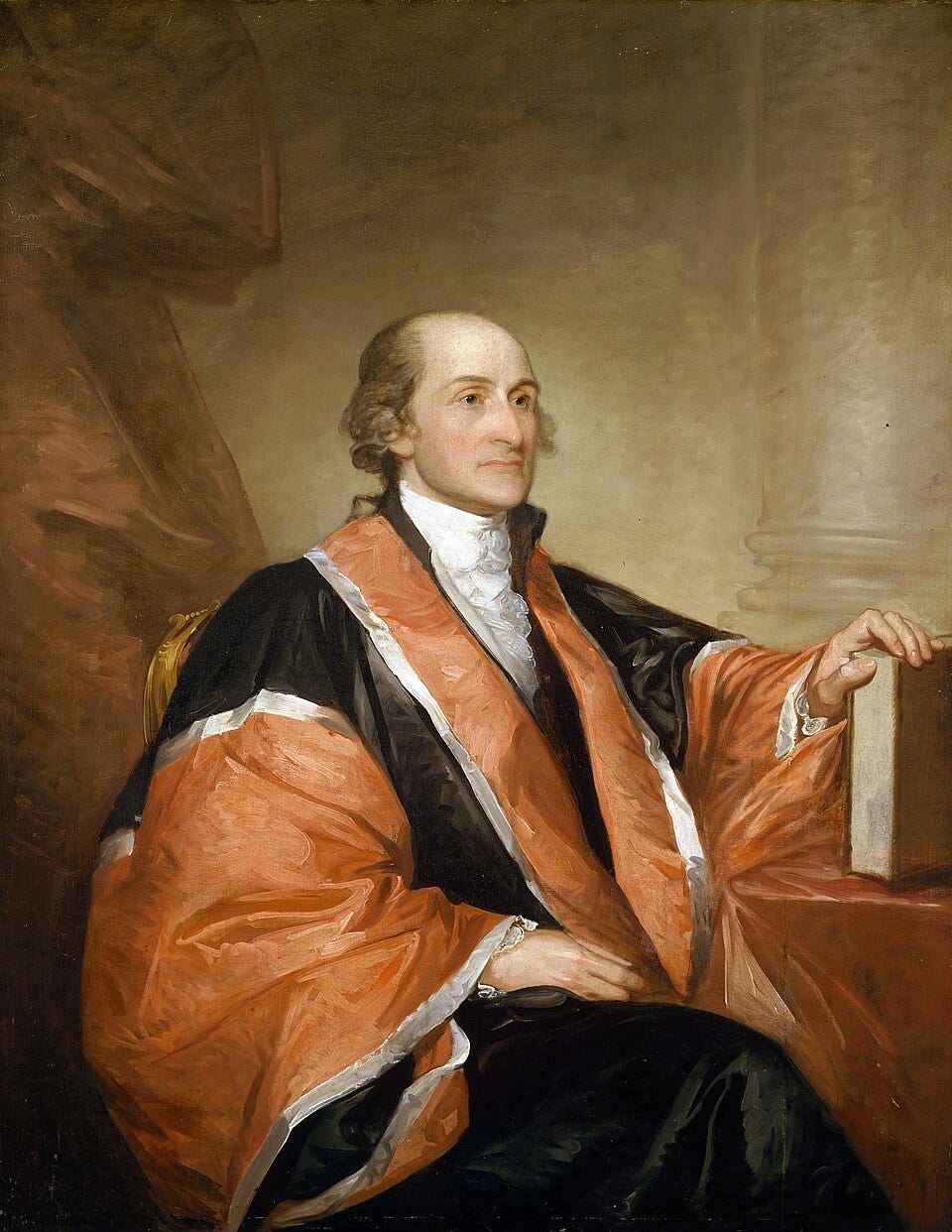
Portrait of John Jay, 1794, by Gilbert Stuart (1755-1828), National Gallery of Art, Washington. Jay served as the first Chief Justice of the Supreme Court at the time of the painting’s completion.